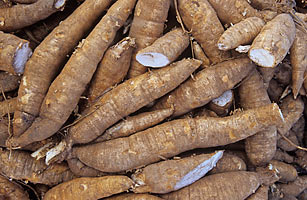
 Cassava
Use of high-yield, disease-resistant varieties like TMS 30572, TME 419, and NR 8082, developed by International Institute of Tropical Agriculture (IITA) and National Root Crops Research Institute (NRCRI). Weed control through manual weeding or herbicides (e.g., Glyphosate, Atrazine). Intercropping with maize, legumes, or vegetables to optimize land use. Irrigation systems used in some areas for dry season farming.
Well-drained sandy loam or loamy soil with a pH of 5.5–6.5, rich in organic matter. Cassava thrives in soils with good aeration and moderate water retention.
Cassava is grown in all states of Nigeria, but the major producing states include Benue, Kogi, Oyo, Ogun, Ondo, Taraba, Imo, Enugu, Edo, Cross River, and Delta. The South-West, South-South, and North-Central regions have the highest production due to favorable rainfall and soil conditions.
Rainy season planting: April–June (major planting season). Dry season planting: November–December (possible with irrigation).
Early varieties: 6–9 months after planting. Late varieties: 12–18 months after planting. Harvesting is done year-round, depending on planting time and variety.
Early-maturing varieties: 6–9 months. Late-maturing varieties: 12–18 months.
and Preparation: Land is cleared, plowed, and ridged for better root development. Mechanized plowing and harrowing are used for large-scale farming. Planting: Cassava is propagated using stem cuttings (25–30 cm long) from mature plants. Cuttings are planted at a spacing of 1 m × 1 m on ridges or flat land. Fertilizer Application: Apply NPK 15:15:15 at 4–6 weeks after planting. Organic manure (e.g., poultry droppings) improves soil fertility.
Use of high-yield, disease-resistant varieties like TMS 30572, TME 419, and NR 8082, developed by International Institute of Tropical Agriculture (IITA) and National Root Crops Research Institute (NRCRI). Weed control through manual weeding or herbicides (e.g., Glyphosate, Atrazine). Intercropping with maize, legumes, or vegetables to optimize land use. Irrigation systems used in some areas for dry season farming.
Common cassava pests in Nigeria include Cassava Mealybug, Cassava Green Mite, and Whiteflies. Control measures: Use of resistant cassava varieties to minimize pest damage. Biological control (e.g., releasing parasitoids like Epidinocarsis lopezi against mealybugs). Insecticide application (e.g., Lambda-cyhalothrin for severe infestations).
Manual harvesting by uprooting cassava roots when mature. Mechanical harvesters used for large-scale farms. Post-harvest processing: Cassava must be processed quickly after harvesting to prevent spoilage. Processing methods: Peeling, washing, grating, fermenting, drying, and milling into different products like garri, fufu, starch, flour, and ethanol.
Nigeria is the world's largest cassava producer, producing over 60 million metric tons annually. Cassava is a staple food (used for garri, fufu, and tapioca) and an industrial raw material for starch, ethanol, animal feed, and biofuel. The government supports cassava farming through initiatives like CBN’s Commercial Agriculture Credit Scheme (CACS), Cassava Transformation Agenda, and Anchor Borrowers’ Programme (ABP). Cassava has high export potential, especially for cassava starch, ethanol, and flour.

© Designed with by Adam Musa Yau